

By Nathan Martin, Founder — LugWrench Heroes Mobile Tire Shop · 20+ years in the tire industry · Mobile tire service across the Phoenix metro since 2020
In Arizona, a tire is too old at about six years from its manufacture date, regardless of how much tread is left, and ten years is the outer limit anywhere. Phoenix is not a random example: when NHTSA needed the most heat-aged tires in the country for its tire-aging research, it collected them here, off Valley cars.
Tread depth tells you how much rubber is left. It says nothing about what a decade of 110°F summers, 150°F pavement and relentless UV has done to the rubber compound and the belts underneath it. This guide shows you how to read the four-digit DOT date code on your sidewall, what the research says about tire age in Arizona specifically, and how to decide when a tire that looks fine has quietly become unsafe.
Key Takeaways
- The Arizona rule: plan on replacing tires at six years from the DOT date even with good tread; never run a tire past ten years anywhere.
- Find the age: the last four digits of the DOT code are the week and year of manufacture — “2319” is the 23rd week of 2019.
- Why here is different: NHTSA chose Phoenix as its “worst case” tire-aging site because rubber degrades faster with temperature, and its lab test simulates four years of Phoenix service.
- Sitting counts: a snowbird car parked May through October ages its tires — and its spare — without adding a mile. See how long a car can sit before the tires go bad.
- What to do: check all five date codes today; if any is past six years, shop replacement tires and we install them at your home or office.
How Old Is Too Old for a Tire?
Most vehicle manufacturers recommend replacing tires at six years from the date of manufacture regardless of tread, and most tire manufacturers set ten years as the absolute maximum. In Arizona’s heat, treat six years as the working limit: NHTSA’s own research found that tires pulled from Phoenix service showed the material changes its lab reproduced with weeks of oven aging, and that aging is a safety concern specifically in Sun Belt states in summer at highway speed.
A tire ages through two mechanisms, and Arizona accelerates both. The first is thermo-oxidative aging: oxygen inside the tire reacts with the rubber, and the reaction speeds up with heat. The second is cyclic fatigue from the tire flexing as it rolls, which is worse when the rubber has already stiffened. The result is a tire that is harder, less flexible and more prone to belt-edge separation — the failure that causes tread to peel off at freeway speed — while the tread depth gauge still reads “fine.”
That is why the age rule and the tread rule are separate tests, and a tire has to pass both. Arizona’s legal tread minimum is 2/32 of an inch; a tire can clear it with room to spare and still be a decade past safe.
How to Read the DOT Date Code
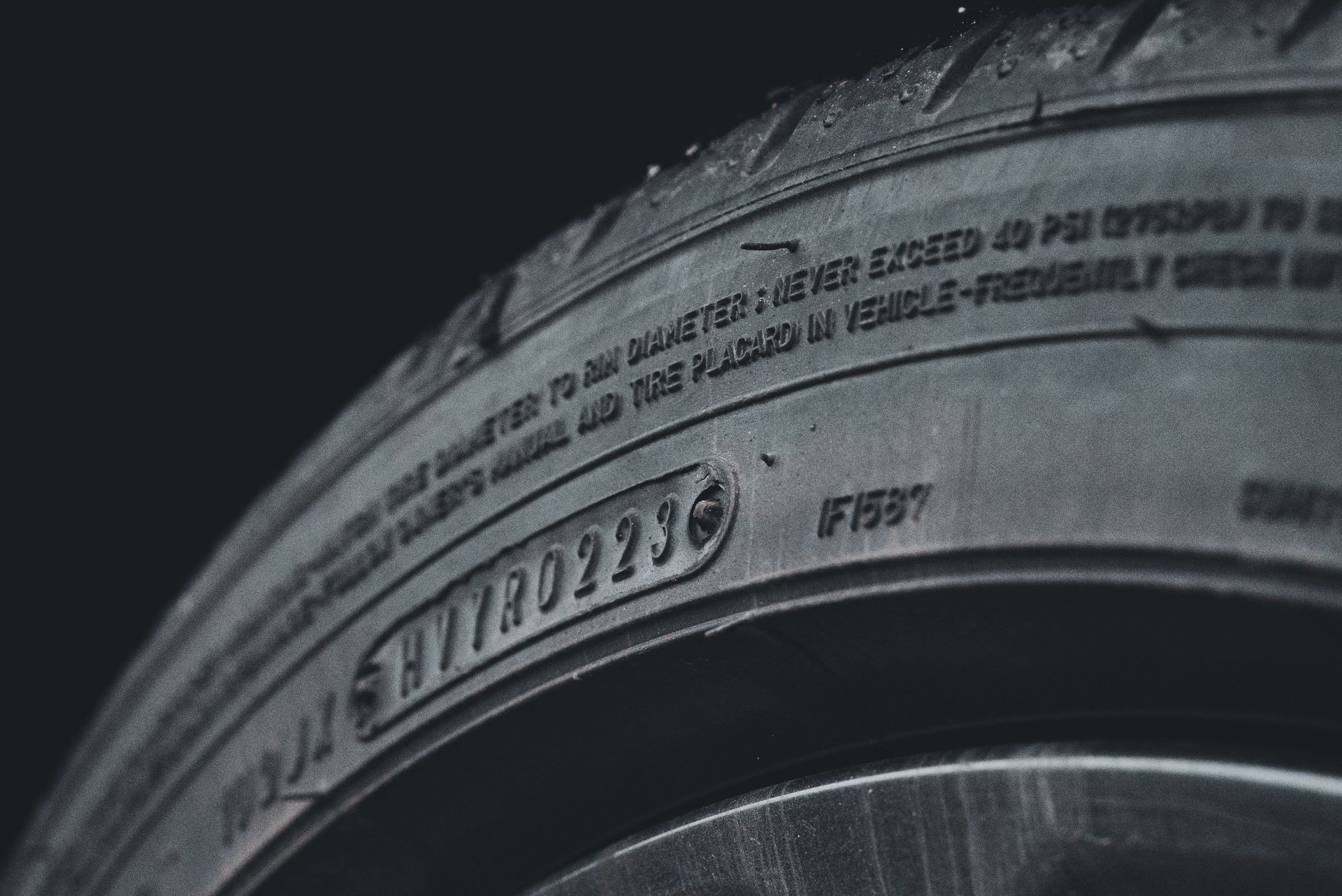
Every tire sold in the United States carries a Department of Transportation code on the sidewall that begins with the letters DOT and ends with the manufacture date. The date is the last four digits: two for the week of the year, two for the year.
Week 23 of 2019 — early June 2019. On September 11, 2026 this tire is seven years and three months old.
Three things trip people up when they go looking:
- The full code is often on one side only. Manufacturers are required to put the complete DOT string, including the date, on at least one sidewall. If you see DOT followed by only a few characters, check the other side of the tire — which on the inboard side may mean crouching with a flashlight.
- Three-digit codes mean the tire is from the 1990s. Before 2000 the date was three digits. If you find one, the tire is at least 26 years old and should be replaced immediately, whatever it is on.
- Check all five. The spare has a date code too, and on many Valley cars it is the oldest tire on the vehicle — often the original from the factory. Read how long you can drive on a spare tire before you count on it.
| Code ends in | Made | Age today | Arizona verdict |
|---|---|---|---|
| 0825 | Week 8 of 2025 (late February) | 1½ years | Fine; inspect annually from year five |
| 3222 | Week 32 of 2022 (August) | 4 years | Fine; start annual inspections next year |
| 1620 | Week 16 of 2020 (April) | 6½ years | Replace — past the six-year Arizona limit |
| 4517 | Week 45 of 2017 (November) | Nearly 9 years | Replace now, regardless of tread |
| 2715 | Week 27 of 2015 (July) | 11 years | Past the ten-year maximum — do not drive on it |
| Three digits (e.g. 239) | 1990s | 26+ years | Remove immediately |
Why Phoenix Is the Tire-Aging Capital of the Country
When NHTSA set out to understand how tires degrade in service, it needed the most aged tires it could find, and it chose Phoenix. The agency’s stated reasoning was that the rate of degradation of tire rubber increases with temperature, so the “worst case” tires would be found in a hot, high-population metro. In 2003 it collected 493 tires off vehicles in the Phoenix area, tested them against new tires, and used the results to build the oven-aging protocol the industry now uses — a protocol NHTSA describes as approximating the aging of a tire with four years of service in Phoenix.
The practical translation: a tire that spends its life on a car in Scottsdale, Mesa or Goodyear reaches the aged condition the federal standard was designed around in roughly four years. That is not a reason to panic at year four; it is the reason the six-year rule is the right one here rather than the ten-year figure you will see quoted for the country as a whole.
Three local factors do the damage:
- Heat. Phoenix pavement exceeds 150°F from May through September, and a tire’s internal temperature climbs further at freeway speed. Heat drives the oxidation that hardens rubber and weakens the bond between the belts.
- UV. Arizona’s year-round sun breaks down the sidewall’s protective compounds, which is where the surface cracking of dry rot starts. Street-parked cars in Arcadia, Ahwatukee or Gilbert age visibly faster than garaged ones.
- Sitting. Aging does not require driving. A snowbird’s car parked in Sun Lakes or Fountain Hills from May to October gains no miles and a full summer of heat; a low-mileage second car or an RV in storage does the same every year. Mileage-based replacement rules miss these vehicles entirely.
Signs a Tire Is Aging Out, Even With Good Tread
Age damage shows up on the sidewall and between the tread blocks before it shows up as a blowout. On any tire past four years in Arizona, look for these on a monthly walk-around:
- Fine cracking on the sidewall or around the lettering — the first visible sign of dry rot.
- Cracks at the base of the tread grooves, which you can only see by bending the tread open with your thumbs.
- A brown or gray bloom on the sidewall that does not wash off — the anti-aging waxes have migrated out and are exhausted.
- Bulges or bubbles anywhere on the sidewall, which means the internal structure has already let go. See what a bubble in the sidewall means.
- A new vibration or hum that balancing does not fix, which can point to internal belt separation.
Any one of these on a tire past six years is a replace-now signal. Any one of them on a tire under six years is a reason to have it inspected before summer. Our mobile tire inspection checks all five date codes, tread depth, pressure and sidewall condition at your location.
| Situation | Tread says | Age says | Verdict |
|---|---|---|---|
| 3-year-old tire, 3/32" tread | Replace soon | Fine | Replace for tread |
| 7-year-old tire, 8/32" tread, garaged | Fine | Past the Arizona limit | Replace for age |
| 5-year-old tire, 6/32" tread, street-parked, sidewall cracks | Fine | Borderline | Replace — visible aging overrides the calendar |
| 9-year-old full-size spare, never used | Like new | Too old | Replace the spare; do not rely on it |
| Snowbird car, tires bought 2021, 18,000 miles | Fine | 5 summers | Inspect before the drive north; plan replacement next year |
Buying Tires in Arizona: Check the Date Before They Go On
A new tire is not necessarily a fresh tire. Tires can sit in a warehouse or on a rack for a year or more before sale, and while properly stored stock is safe to sell, in Arizona that shelf time comes straight out of your six years. Ask for the DOT date on any tire you buy; reputable sellers will tell you, and the industry practice is to avoid selling stock that is more than a few years old. Two other things worth doing when you replace a set:
- Buy four with matching dates when you can. A set with one tire two years older than the others hits the age limit at four different times and gets replaced piecemeal.
- Replace the spare when it hits the limit, even though it has never touched the road. It is the tire you will need at the worst moment.
When we bring tires to you for a mobile tire installation, the DOT date is on the sidewall for you to read before the old tires come off, and the mounting is done with a touchless machine that never touches the wheel face. If you are not sure whether age or wear is your issue, how long tires should last in Phoenix covers the mileage side of the question.
Tire Age FAQ
How long are tires good for after the DOT date?
Six years is the working limit in Arizona and the figure most vehicle manufacturers use; ten years is the maximum most tire manufacturers allow anywhere, regardless of tread or appearance. The clock starts at the manufacture date on the sidewall, not the purchase date. Between years five and ten, a tire should be inspected by a professional at least once a year.
Is it okay to use 10-year-old tires?
No. Ten years is the point at which tire manufacturers say to replace a tire no matter what, and in Phoenix a ten-year-old tire has lived through ten summers of heat that NHTSA’s research identifies as the harshest tire-aging environment in the country. The tread can look excellent; the belts and inner liner have still aged out. Replace it, and check the spare, which is usually the same age.
Are 7-year-old tires too old in Arizona?
Yes, by the six-year Arizona rule. A seven-year-old tire that has been garaged, kept at pressure and shows no sidewall cracking is not an emergency, but it is due, and it should not be driven at freeway speed through another summer. If it is street-parked or shows any cracking or bloom, replace it now.
Is it okay to buy tires that are already 2 years old?
Properly stored, a two-year-old tire is safe and is common in the supply chain. The catch in Arizona is that those two years count against the six you get, so a two-year-old tire is a four-year tire once it is on your car. Ask for fresher stock if it is available, and make sure all four tires in a set carry similar dates.
Do tires expire if they are never used?
Yes. Oxidation and UV exposure do not require the tire to roll, which is why a spare that has never been on the ground still ages out, and why a car that sits all summer in Sun City or Gold Canyon needs its tire dates checked before its first long drive. Storage in a cool, dark garage slows aging considerably; a driveway or an open carport in Phoenix does not.
Not Sure How Old Your Tires Are? We’ll Check All Five.
Mobile tire inspection, installation and repair at your home, office or job site across the Phoenix metro — backed by a 45-day ride guarantee.
Call or Text (602) 492-8495Book Online Shop Tires
LugWrench Heroes Mobile Tire Shop · 4665 S Ash Ave Suite G-7, Tempe, AZ 85282 · Mon–Fri 8 AM–5 PM, Sat 8 AM–3 PM · Mobile service — we come to you